Applications for formal acceptance into the Surgical Technology Program are accepted once a year. Applications are available at the top of this page, or in the Surgical Technology Program Director’s office, BC 123-A. Applications must be submitted no later than November 1. Late and/or incomplete applications will not be considered.
In order to be considered for acceptance into the Surgical Technology program, the student must have
- Completed or be currently enrolled in the required prerequisite courses with a grade of “C” (74%) or higher. A grade lower than 74% is not acceptable in the prerequisite courses;
- Completed BIOH 201, BIOH 211 and BIOM 250 within five years of acceptance into the program. Individuals may request evaluation by the Surgical Technology Program Director for a possible exception to this policy.
- Been admitted to FVCC with all required records on file; and
- Submitted a complete application on or before November 1.
Students will be informed of their conditional admission status by December 15. Final acceptance will be contingent upon completion of prerequisite courses with a grade of “C” (74%) or better and passing a criminal background check.
- This is a demanding program. Individuals will be required to actively participate in and subscribe to the legal and ethical standards of the discipline while enrolled as a student and as a graduate.
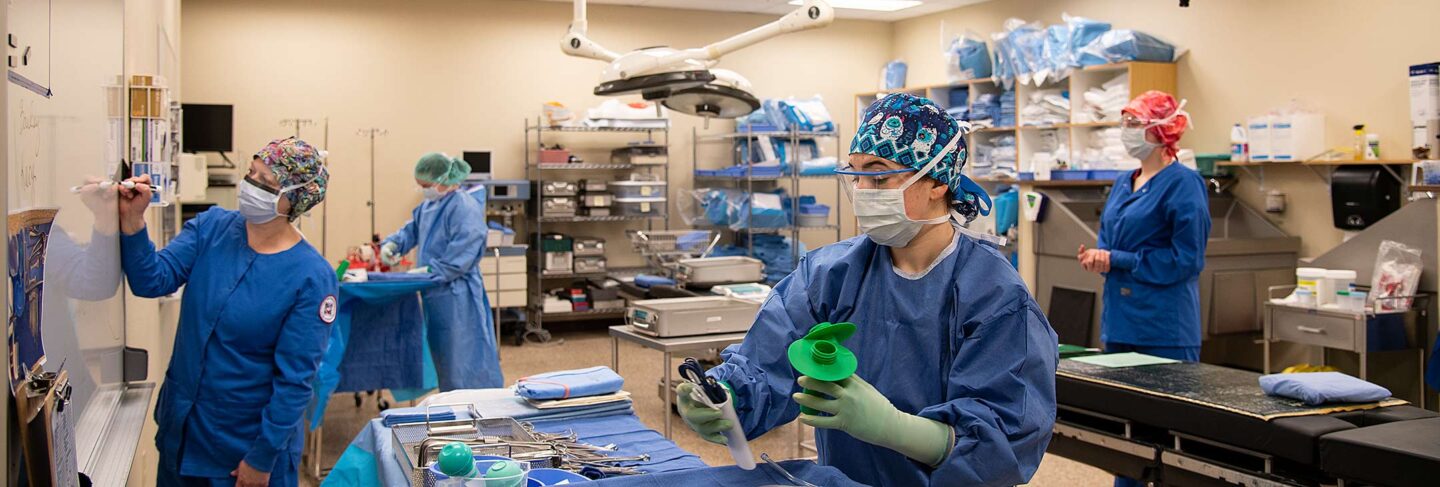
- Upon completion of the prerequisite courses, specific surgical technology (AHST) courses total three semesters. Surgical technology specific courses include both classroom (didactic) and hands-on (laboratory and clinical) training.
- This program has been designed in accordance with the Core Curriculum for Surgical Technology, 7th edition and functions within the current standards and guidelines set forth by the Accreditation Review Council on Education in Surgical Technology and Surgical Assisting (ARC-STSA), sponsored by the Commission on Accreditation of Allied Health Education Programs (CAAHEP).
- Once a student has applied and been accepted into the Surgical Technology program, each AHST course must be passed with a grade of “B-” or higher to continue in the program.
Additional Costs: Students will be assessed course fees per semester for durable lab items, AST membership dues, miscellaneous clinical/lab program fees, and the NBSTSA certification exam. Students are also required to purchase surgical attire including scrubs, designated operating room shoes, and safety glasses. Costs associated with travel to various locations required for clinical rotations will also be incurred.
Students will be eligible to take the national certification exam administered by the National Board of Surgical Technology and Surgical Assisting (NBSTSA) at the end of the program. Passing the national examination qualifies the individual as a Certified Surgical Technologist (CST®). The Association of Surgical Technologists (AST) recommends that all surgical technologists obtain this certification.
Minimum program expectations: To prepare entry-level Surgical Technologists who are competent in the cognitive (knowledge), psychomotor (skills), and affective (behavior) learning domains to enter the profession.
Opportunities after Graduation
Most surgical technologists work full time. Surgical technologists employed in hospitals may work or be on call during nights, weekends, and holidays. They may also be required to work shifts lasting longer than eight hours.
The largest employers of surgical technologists are as follows:
| Hospitals: state, local, and private |
71% |
| Outpatient care centers; ambulatory surgical centers |
12% |
| Offices of physicians |
12% |
| Administrative and support services |
2% |
| Offices of dentists |
1% |
Accreditation
The Surgical Technology Program is accredited by the Commission on Accreditation of Allied Health Education Programs (www.caahep.org) upon the recommendation of the Accreditation Review Council on Education in Surgical Technology and Surgical Assisting (ARC/STSA) (arcstsa.org).
CAAHEP (caahep.org)
9355 – 113th St. N, #7709, Seminole, Florida, 33775
P: (727) 210‐2350
F: 727-210-2354
E: mail@caahep.org
ARC/STSA (arcstsa.org)
19751 East Mainstreet, Suite #339, Parker, Colorado, 80138
(303) 694-9262
info@arcstsa.org
Program Outcomes
ARC/STSA establishes minimum thresholds for various program outcomes to ensure quality and compliance with their standards. These thresholds are crucial for maintaining accreditation and are used to assess program performance and ensure that graduates are well-prepared for their roles in the surgical field. The FVCC Surgical Technology Program 5-year trend is 93% Retention Rate, and 92% CST Exam Pass Rate.
Students who complete the Surgical Technology Program are eligible to take the Certified Surgical Technologist exam administered by the National Board of Surgical Technology and Surgical Assisting (NBSTSA). Program administrators at FVCC assist students in the application process and arrange for prospective graduates to take the exam on campus during the final week of the program. Upon passing the exam, the graduate is qualified to seek employment as a CST working in hospitals, day surgery facilities, or with surgeons in their practices.
TRENDS DATA FOR RETENTION RATE AND CST EXAM PASS RATE
| Graduation Year |
Students Initially Enrolled |
Students Graduated |
Retention Rate |
# of Students Attempting CST Exam |
# of Students Passing CST Exam |
Pass Rate |
| 2025 |
4 |
4 |
100% |
4 |
4 |
100% |
| 2024 |
3 |
3 |
100% |
3 |
2 |
67% |
| 2023 |
4 |
3 |
75% |
3 |
3 |
100% |
| 2022 |
12 |
11 |
92% |
11 |
10 |
91% |
| 2021 |
5 |
5 |
100% |
5 |
5 |
100% |